AD NULLUM

Ad Nullum: Sol · 2154

Governments collapsed.Take your share of Sol.

Ports became polities. Corporations absorbed infrastructure. Families bought sovereign land. Armed groups turned protection into authority. A century of public wealth is settling into new hands.

Get rich. Buy influence. Put your people in charge. In 2154, the institutions that will dominate the next century are still being assembled.

Early development. The game is still being built; the simulation beneath it is live.

01 / Faction constitution

Choose the people who survive the century.

Families, corporations, movements, faiths and syndicates all accumulate power differently. Pick the bond that holds your inner circle together.

The constitution of power

Your faction is the part that endures.

It decides who belongs to the trusted core, how leadership passes on, and which people still stand with you when ambition becomes dangerous.

Every faction can pursue every activity. The constitution changes the internal price.

Example faction

House Vane DE VAART DUURT VOORT
BREED

Family / Breed

Family House

Blood, marriage and inheritance create a small trusted core. Professionals can supply whatever talent the family itself does not produce.

Trusted core
Kin
Who can join
Born, married or adopted into the house
Agents
Kin are loyal; professionals widen the talent pool
Succession
Inheritance and family trusts
Main pressure
Bad heirs and competing branches
Strengths
Fault lines

Trusted kin can become near-perfect agents.

Choose opening leverage

02 / Opening leverage

How do you start taking your share?

Choose the first thing your faction already knows how to turn into power.

SHIPPING

EARTH HAS SURPLUS. TITAN IS SHORT.

Get there before somebody else does.

Shipping / Own movement

You begin with

A small fleet · working capital · commercial relationships

A shortage has opened a spread between Earth and Titan. Commit cargo, choose how hard to burn, and arrive while the price is still yours to capture.

  1. 01
    Spot the imbalanceFood is cheap at origin and scarce at destination.
  2. 02
    Commit capitalBuy cargo, reserve fuel and pick the vessel.
  3. 03
    Beat the marketArrive before rival capacity closes the spread.
If it works Route → carrier → terminal → logistics house

The first fortune buys another ship. The fifth route justifies a terminal. Eventually other people build their businesses around your schedule.

Your run: Family House · Merchant Dynasty / Shipping

Continue: how you lead →

03 / Core mechanic

Power has a face.

The Principal is always the de facto leader of your faction — and the one person you control completely. Everyone around them remains an autonomous person with assets, offices, relationships and ambitions of their own.

FamilyDeath
CorporateBoard vote
IdeologicalChallenge
ReligiousConclave
SyndicateCoup / removal
DIRECT CONTROL Senior house head

The senior family leader is the Principal. Leadership is personal and usually lasts for life.

FAMILY / BREED

The constitution decides when control moves to another person.

CURRENT PRINCIPAL Senior house head
TRANSFER TRIGGER DEATH
NEW PRINCIPAL Senior successor

The next senior house leader becomes Principal. Inheritance separately decides where shares, ships, land and trusts actually go.

WHAT HAPPENS TO THE OLD PRINCIPAL?

The former Principal is gone, while their estate, promises, appointments and relationships continue to shape the house.

CONTROL VS OWNERSHIP

Leadership and ownership often overlap, yet the estate can fragment across heirs even while one person becomes head of the family.

Why staying in power matters

Tenure compounds control.

Family Principals can remain in power for decades, allowing unusually deep personal loyalty and patronage to accumulate.

Rare transitions · high transition shock
YEAR 1 Office

You hold the position.

YEAR 10 Appointments

Your people occupy the structure.

YEAR 25 Personal machine

Loyalty, reputation and relationships now reinforce one another.

Everyone else remains themselves

Loyalty determines how much of the faction behaves like your own hand.

100AlignedActs almost like a directly controlled unit.
75ReliableUsually follows faction strategy.
50ConditionalCooperates while interests overlap.
0AutonomousPursues their own interests entirely.
Keep your Principal in power and personal control compounds. Lose them, and the faction survives — but the human network around the new leader must be built again.

04 / What can you take?

Start with a ship.
End with a jurisdiction.

Power in Sol is tangible. Buy it, inherit it, win it, finance it, capture it or place one of your people inside it.

Interplanetary freight vessel
01

A ship.

Own the hull. Charter it, arm it, borrow against it, or put it to work.

Small body in deep space
12

An asteroid concession.

The rock can stay where it is. The right to extract from it can belong to you.

Settled orbital world
31

Land.

Habitats, launch corridors and infrastructure can turn empty ground into permanent rent.

Political and corporate gathering
56

An office.

Your daughter signs the permit. Your ally awards the concession. Authority becomes part of the portfolio.

Private sovereign estate
88

A demaine.

Territory, taxation, infrastructure and law. At the far end of the climb, your faction enters the ruling architecture of Sol.

One possible rise

SHIP→FLEET→TERMINAL→PORT AUTHORITY→DEMAINE

Family House · Merchant Dynasty + Shipping

A shipping faction turns movement into infrastructure, then uses control of access to buy political weight.

World simulation / shared primitives

The world plays by the same rules.

NPC factions own assets, borrow, invest, hire, trade, vote, fail, fight and reorganise using the same systems available to the player. Remove the player and Sol should still generate history.

01Mine

Needs capital, labour and freight.

NPC OWNER
DEBT
02Bank

Prices risk and funds expansion.

BALANCE SHEET
FREIGHT
03Carrier

Allocates ships to actual margins.

ROUTES
INPUT
04Refinery

Buys feedstock and sells output.

CAPACITY
TAX / DEMAND
05City

Consumes, employs and governs.

POPULATION
Same primitivesNo NPC-only economy.

Ownership, governance, credit, logistics and force use one canonical world model.

Deterministic intelligenceAgents make bounded decisions.

Priorities, forecasts, constraints and risk appetite drive behaviour without requiring an LLM in the loop.

World firstConsequences propagate.

A bank failure can hit a mine, freight demand, employment, land values and politics because those links are real.

The test: run fifty years with zero human players. The world should still be worth watching.

Governance / frontier economics

Sovereignty is something you pay for.

Outside a demaine, property and economic activity can exist without a territorial government. Effective control matters. A recognized demaine converts a contiguous territory into protected governance — together with every resident and every recurring Compact bill inside it.

Illustrative fragmented demaine map of Ecuador
EXTRAJURISDICTIONAL Control the asset. Defend it yourself.

CONTROL WITHOUT SOVEREIGNTY

Your mine can be yours without the land around it becoming a state.

Compact registries can recognize ordinary title inferred from sustained control. Security remains private, collective or contractual, and a rival can still try to displace you if the expected cost is worth it.

Private attackPossible
Governance titleNone
Population liabilityNone
Compact duesNone
IF YOU FOUND A DEMAINE BASE FEE + POPULATION × RATE + AREA × RATE

You can tax the economy inside the border. Poor residents still cost money. Empty land still costs money. The Compact is perfectly happy to recognize your sovereignty and send the invoice.

VALUABLE ASSET→INFRASTRUCTURE→FORMAL ECONOMY→TAX BASE→DEMAINE?

Development can eventually make sovereignty affordable. Until then, prosperity also makes the region more worth defending.

Starting grammar / no fixed classes

Starts are compositions.

Your constitution says how the faction holds together. Competence says what it knows how to do. Starting leverage says what it already controls. Their combination determines what sort of institution you actually begin as.

01 / Constitution
02 / Core competence
03 / Starting leverage
ILLUSTRATIVE START

Investment vehicle / bank

A corporate faction with financial competence and a property/capital base begins as an institution that allocates capital rather than producing goods directly.

creditpropertygovernance
Corporate + Logistics + ShipsShipping company
Corporate + Mining + ConcessionMining corporation
Family + Finance + ProprietorMerchant dynasty / family office
Syndicate + Logistics + ShipsSmuggling network
Religious + Property + ServicesInstitutional church economy

04 The world in 2154

Post-collapse / Postwar / Pre-boom

Civilisation changed hands.
Power found new owners.

For nearly a century, old states lost capital, tax revenue and control. Ports became polities. Corporations absorbed public infrastructure. Families bought sovereign land. Guilds took over cities. Mars built the one thing Earth no longer had: a unified command.

Then Mars overreached. The Corridor War forced Earth's rival demaines to cooperate just long enough to win. In 2154 they replace occupation with a new Compact of shared rules, registries and access.

The old order is dead. The new one is liquid. This is when fortunes are made.

2154. Deimos has been returned. The peace has rules now. Almost nobody knows yet what those rules will be worth.
What happened to the nation-state?+

Capital fled toward orbital infrastructure while collapsing tax enforcement made evasion rational. Governments lost the revenue needed to sustain courts, welfare, borders and administration. Successor institutions kept the useful parts running: ports, utilities, exchanges, launch corridors, corporate territories and local polities.

Why did Deimos matter?+

Mars used its unified military to impose transit taxes and corridor control on a fragmented Earth. In 2152, Randstad logistics, Singaporean coordination, Manhattan finance and a temporary coalition fleet captured Deimos. Retaking it would have meant risking everything. The settlement that followed became the foundation of the Compact.

What is the Compact?+

Not a replacement world government. It is a framework that makes trade, contracts, transit and enforcement work across radically different demaines. Joining is voluntary. Staying outside becomes more expensive as everyone around you joins.

Who actually holds power?+

The Randstad controls enormous port and financial infrastructure. Manhattan concentrates capital. Kairos fuses corporation and polity in Singapore. Mars retains the system's largest cohesive military. Families such as the Vanes hold ships, influence and even sovereign territory. Elsewhere guild cities, enclaves, concessions and pirate alcoves fill the gaps.

05 Power across generations

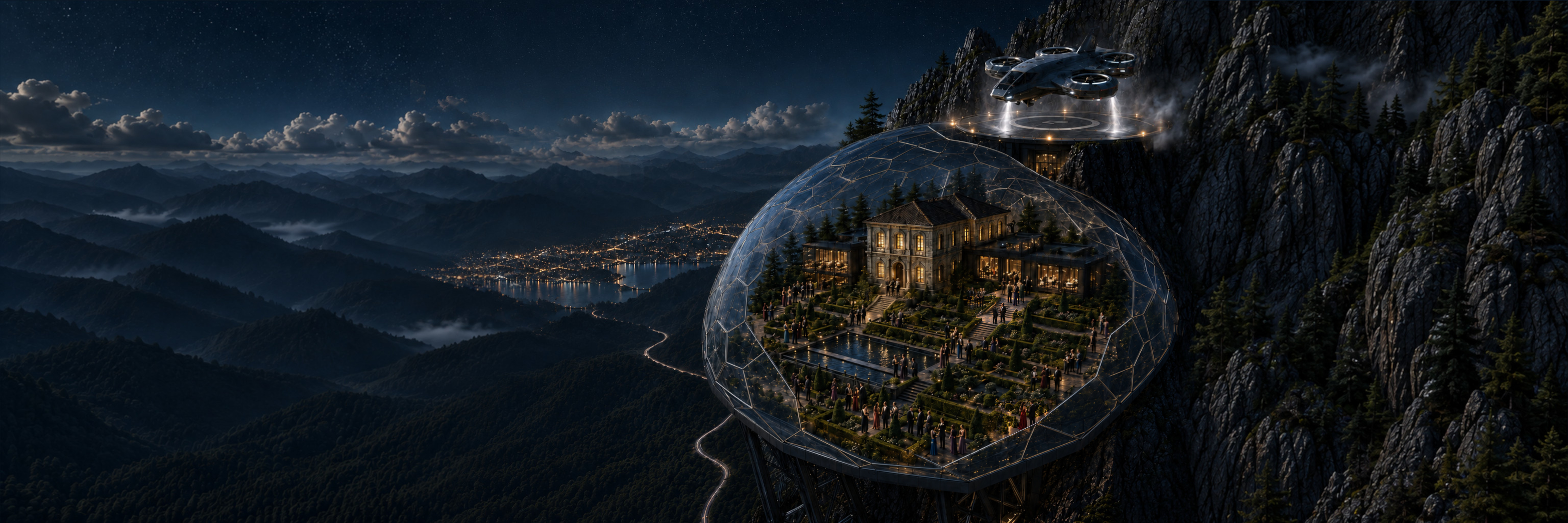
Two people at an evening gathering in the Ad Nullum universe
People inherit assets. Institutions inherit consequences.

Your group outlives the company

Build something that survives its founders.

You play the people behind the assets: a family, a controlling shareholder group, a corporate leadership structure or another enduring power base.

Your founders age. Children inherit. Directors are recruited. Partners accumulate influence. The organisation can grow far beyond the people who created it—but those people still decide who controls what happens next.

Family house / Vane model

Loyalty is inherited. Talent is not.

Raise heirs, arrange succession and live with the people the family produces. A family can keep control for generations—but it cannot recruit a better son.

Corporation / Kairos model

Talent can be hired. Loyalty cannot.

Recruit directors, buy expertise and replace weak operators. A corporation can choose its people far more freely—but those people have careers, factions and interests of their own.

People need seats of power

ChairCEOFleet DirectorIndustrial DirectorSecurity ChiefPolitical Representative

A brilliant outsider may run your industries better than your loyal nephew. The outsider can also leave. The nephew can also be an idiot. Appointments turn character problems into economic problems.

06 A century in Sol

2154–2260s / History keeps moving

Build across generations.
Survive the age you helped create.

The campaign begins when the Compact is fragile and ends after more than a century of consolidation, frontier growth and accelerating exploration. The historical pressures are fixed. Who profits from them is not.

  1. 2154

    The Settlement

    The Compact begins as an alternative to permanent occupation.

    Deimos returns to Mars. The combined Earth fleet disperses. New transit rules replace blockade and tolls. If your fortune depends on access, contracts or enforcement, the rulebook has just been rewritten.

  2. 2160s

    Institution building

    Human coordination proves too political to scale.

    Common adjudication and sortition harden into institutions because two hundred demaines trust impersonal procedure more than they trust each other's judges. Politics begins migrating into protocol design.

  3. 2160–80s

    The accession wave

    The Compact absorbs holdouts through access and economics.

    Non-members watch access to ports, clearing and registered corridors get progressively worse as the network expands. Staying sovereign becomes an economic position with a mounting price.

  4. 2180s

    Registry crisis

    Trust itself becomes a distressed asset.

    Fraud inside a major registry operator cascades through certificates and finance. Ownership, collateral and counterparties that looked unquestionable yesterday can become disputed overnight.

  5. 2190–2210s

    The outer system

    Distance starts rewriting governance.

    Commercial activity moves farther from Earth. Concessions, autonomous registries and algorithmic authority become more important because real-time human oversight simply cannot keep up with commerce.

  6. 2230

    The frontier economy

    Ceres clears the Belt. Ganymede anchors the outer system. The next fortunes are still wildcat.

    Some regions are mature logistical machines. Others are wildcat crews, survey teams and half-built infrastructure. Everybody can see where value may emerge. Almost nobody agrees who will own it.

  7. 2240s

    The exploration boom

    Capital begins chasing a new frontier.

    Deep-space research, specialist engineering, long-range logistics and frontier concessions reprice rapidly. Old industrial portfolios suddenly look conservative; obscure technical firms become strategic assets.

  8. 2260s

    The Age of Expansion

    The Solar System you started in no longer exists.

    Exploration is in full swing. Population, capital and industrial capacity are being reorganised around opportunities their founders never had. The first game's campaign closes as this new order becomes dominant.

World events reprice your holdings

They reprice what you own.

A registry scandal can freeze your collateral. Compact accession can make a port concession suddenly valuable. A new corridor can turn cheap land into a fortune. An exploration boom can make yesterday's specialist supplier the most contested acquisition in the system.

History is fixed. Your position is not.

The Compact will mature whether you are ready or not.

You may help write its rules, profit from them, remain outside them, or build a business around the people trying to evade them.

Failure can be survivable

A company can die without ending the campaign.

Lose the fleet. Default on a subsidiary. Fall out of office. If your people still hold property, claims, relationships or capital, the house can retreat and rebuild.

07 Control mechanics

How control actually works

Ownership has layers.
Control comes from stacking them.

Equity, voting rights, debt, concessions, leases and management rights can all point at the same underlying asset. The strongest positions combine several of them.

A minority shareholder can control an enterprise through fragmented voting. A creditor can force a restructuring. A concession holder can operate infrastructure owned by somebody else. Political office can change the value of every position at once.

Control has many forms

Control can sit in the contract.

EquityVoting rightsDebtConcessionsLeasesManagement rights

Own 31% of a refinery and still control it. Own no port at all but hold its forty-year operating concession. Hold a demaine's debt and discover that creditors can have political opinions.

A great estate representing accumulated private power

Mining + Industry + Shipping

Own the ore. Refine it. Move it.

What began as one concession becomes a vertically integrated combine whose competitors increasingly depend on your infrastructure.

Proprietor + Politician

Own the district. Then write the rules around it.

Property and political power compound each other—until the public decides your family has compounded enough.

Pirate + Bounty Hunter + Politics

Yesterday's outlaw. Tomorrow's government.

Control a corridor, sell protection, gain legitimacy and discover that the difference between piracy and sovereignty can become surprisingly administrative.

08 Force

Combat is part of the economy

Some fortunes are built by force.

Trade attracts predators. Wealth attracts rivals. A valuable route may need escorts. A bounty may need to be taken alive. A pirate may prefer your cargo to your continued existence.

Intercept, raid, escort, blockade, pursue and defend. At small scale, individual armed ships matter. At large scale, commanders, doctrine, logistics and private fleets matter more.

Violence sits inside the economy. It is one of the ways power changes hands.

Interception / Escort / Raid

Who owns the route depends on who can keep it.

Old power / House Vane

Sol is already owned.

The great houses, corporations and political interests arrived generations before you. The Vanes already have roots in the Randstad, shipping interests across Sol, an ancestral Hook estate and a sovereign Andean domain bought from a failed state.

Even they cannot own everything. The Randstad can outvote them. Ambato refuses to sell. Their mountain estate depends on infrastructure controlled by neighbours wealthy enough to refuse their money.

You begin beneath their notice, as one more small actor in a system they already know how to shape.

Build until that changes.

09 The living world

The simulation is already live

The world beneath the game is already moving.

The public Sol simulation already runs interplanetary traffic, markets, production, fuel economics, physical routes, pirates and escorts. It is the foundation the game is being built on top of.

Open the live Sol simulation

Living design scratchpad

World model / mechanics to preserve.

This page is also a working design notebook. These are architectural ideas worth keeping even where the presentation layer changes later.

AGENCY & FACTIONS

One faction. One Principal. Everyone else is autonomous.

The player is strategically the persistent faction and experientially its current de facto leader. Constitution determines how leadership transfers. Long tenure compounds appointments, loyalty, reputation and personal networks.

  • Personal and institutional balance sheets remain separate.
  • Corporate Principals often own very little of the corporation.
  • Dynastic capture of a corporation is possible, valuable and politically costly.
  • Loyalty determines how much of another character behaves like direct control.
ECONOMIC REALITY

NPCs use the player's economy.

Firms, banks, households and factions should make bounded deterministic decisions from the same markets, contracts and ownership structures available to a human.

  • Compact Credits coexist with local demaine currencies.
  • Banks carry real assets, liabilities, liquidity and FX exposures.
  • Central-bank policy and bank resolution vary by demaine.
  • Bid/offer exchanges, credit and financial crises emerge from actual balance sheets.
TERRITORY & FORCE

Sovereignty, title and control are different things.

Demaine governance claims are Compact-recognized and do not transfer through occupation. Outside demaines, ordinary title can follow sustained effective control and security remains a private or collective problem.

  • Demaine dues = base + inhabitants + km².
  • Private combat is impossible inside recognized demaines.
  • Low-governance regions can remain peaceful because most assets are not worth attacking.
  • Violence can still be driven by deterrence, revenge, ideology, security or internal politics rather than immediate profit.
SPATIAL RESOLUTION

Semantically specific now. Physically richer later.

Every important physical asset should already know enough about itself that a future 3D renderer could instantiate it without contradicting the simulation.

  • System → planet → region → city → parcel → facility → vehicle.
  • Major logistics flows resolve into legible trucks, trains, tugs and ships.
  • Facilities track area, floors, equipment, capacity and interfaces before those details are rendered.
  • A future city builder becomes a higher-resolution resolver of the same canonical world.
FRONTIER DEVELOPMENT

Prosperity creates both tax capacity and something worth taking.

An extrajurisdictional mine can seed infrastructure, employment, banks and a city. If the resulting economy becomes productive enough, founding a demaine can finally pay for itself.

  • Development raises the future tax base.
  • Development also raises the present defence requirement.
  • Security mutuals and commercial defence can bridge the gap.
  • NPCs can accidentally grow extraction enclaves into functioning states.
EXTENSIBILITY

New games deepen the same reality instead of replacing it.

Sol can ship with abstract cities and later add richer city, facility and character-scale views. The same world objects persist through every resolution.

  • City building plugs into real external demand, credit and freight.
  • 3D is a representation layer rather than a prerequisite for the simulation.
  • Later games can reuse the same characters, firms, assets, rights and institutional primitives.
  • The long-term MMO becomes an accumulation of proven world layers.

Follow the build / No preorder

Would you want a piece of Sol?

If this sounds like your kind of strategy game, join the development list. We will only write when there is a meaningful milestone, test or playable build worth showing.

No weekly newsletter. No preorder. Unsubscribe whenever.

Privacy information